


Nature - 2019 September - Vol 573 No 7783
Publisher: Nature
Format: Paperback
ISBN: 9770028083095
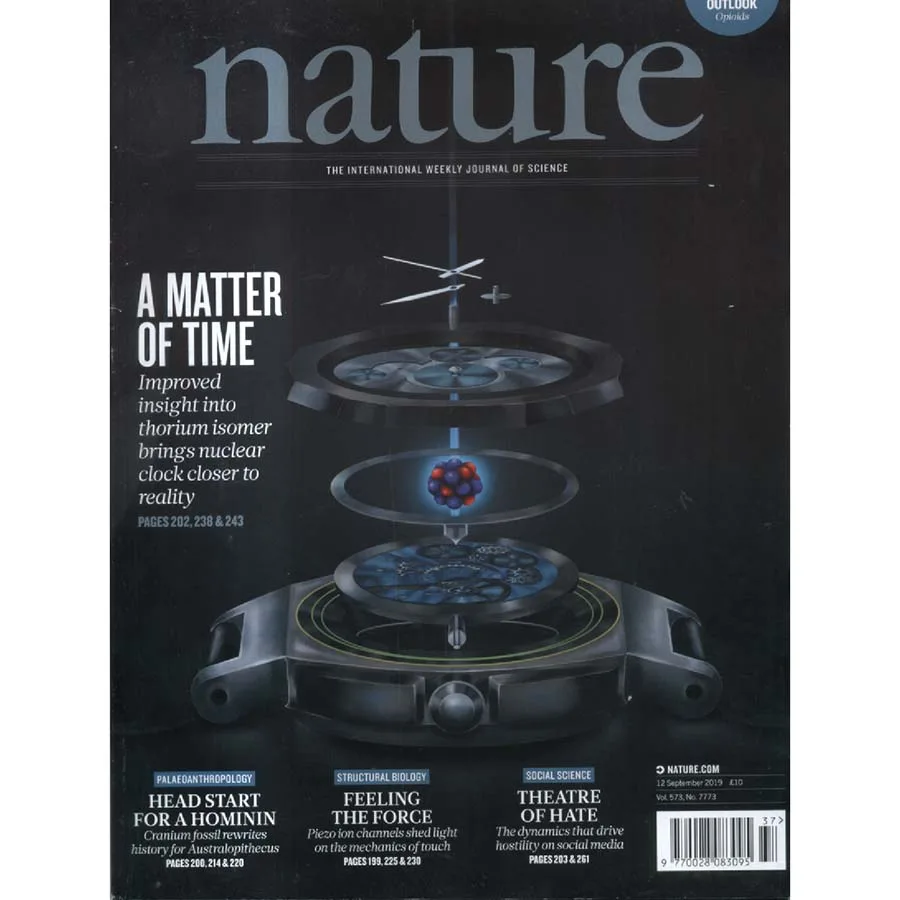
There are some issues of Nature that gently introduce readers to scientific progress, and then there are issues that casually place an exploded futuristic timepiece containing a glowing atomic nucleus on the cover while discussing the future of nuclear clocks as though this is perfectly ordinary bedtime reading. Nature – September 2019, Vol. 573 No. 7773 belongs magnificently to the latter category.
The headline:
A MATTER OF TIME
sounds reassuringly philosophical until one notices the accompanying explanation:
“Improved insight into thorium isomer brings nuclear clock closer to reality.”
At which point most readers experience the familiar Nature sensation of realising civilisation is apparently advancing far faster than they had emotionally prepared for.
The cover artwork is superb. Floating mechanical watch components surround a glowing atomic core like a luxury Swiss timepiece designed by a particle physicist during an existential crisis. It radiates the exact energy of “the future,” specifically the version imagined by extremely intelligent people who own precision instruments worth more than small houses.
And that is the joy of Nature: every issue quietly reveals that humanity is building astonishing things somewhere behind laboratory doors while ordinary life continues obliviously nearby.
The concept here is wonderfully strange. Scientists are investigating nuclear clocks — devices potentially far more precise than current atomic clocks — using the properties of thorium nuclei. Which means humanity has reached the stage where measuring time itself apparently requires nuclear-level refinement because ordinary atomic accuracy is no longer sufficiently ambitious.
Meanwhile, most of us still use phones that randomly insist it is Tuesday after software updates.
Elsewhere in the issue:
-
palaeoanthropologists reassess fossil rewrites of human ancestry,
-
structural biologists investigate the mechanics of touch,
-
and social scientists analyse hostility on social media,
which is perhaps the single most unintentionally funny combination of subjects imaginable. Humanity simultaneously explores:
-
the origins of our species,
-
the molecular basis of physical sensation,
-
and why strangers become deranged online beneath newspaper articles.
Science truly studies the full spectrum of existence.
Reading these 2019 Nature issues now produces a fascinating emotional effect. The late 2010s represented a peculiar threshold period where:
-
AI was accelerating,
-
precision physics was advancing,
-
climate concern was intensifying,
-
and biological sciences were exploding with discovery.
The future was visibly arriving, yet still retained a kind of optimistic intellectual glamour before the following decade introduced several prolonged reality malfunctions.
And through it all, Nature remained gloriously composed. There is something deeply reassuring about scientific journals calmly documenting humanity’s increasing mastery of reality while never losing their formal editorial tone. Entire paradigms may shift, but the typography remains tasteful and the peer review process continues without panic.
The visual culture of modern science publishing deserves admiration too. Scientific illustration has evolved into a kind of conceptual art form. Nuclear clocks, molecular interactions and cosmic structures now appear rendered with the cinematic grandeur once reserved for science-fiction films. One could easily frame this cover and convince visitors it represents a prestigious contemporary art print about time and mortality.
Physically, this issue has the unmistakable aura of high-level intellectual seriousness. One imagines it originally sitting in:
-
physics departments,
-
advanced research institutes,
-
university libraries,
-
or on the desks of people capable of explaining thorium isomers without requiring several hours and a whiteboard.
Yet now it survives as both scientific document and cultural artefact from a fascinating moment in technological history — an era when humanity was pushing precision measurement, biology and computational understanding ever further while still vaguely pretending the future would remain manageable.
Condition-wise, this copy is listed as Good, meaning it has survived admirably despite likely exposure to academic offices, careful coffee balancing and at least one reader who fully intended to understand the nuclear clock article before quietly realising they may not possess enough physics.
Today, Nature – September 2019, Vol. 573 No. 7773 stands as a brilliant snapshot of modern scientific ambition: elegant, intimidating and quietly astonishing in the scope of what humanity now attempts to understand.
An excellent acquisition for science enthusiasts, collectors of intellectual ephemera, physics admirers or anyone who enjoys magazines capable of making them feel simultaneously fascinated by the future and deeply suspicious that the scientists are already living several decades ahead of everyone else.
Keep browsing: See more Nature Journal books Other books by Nature
